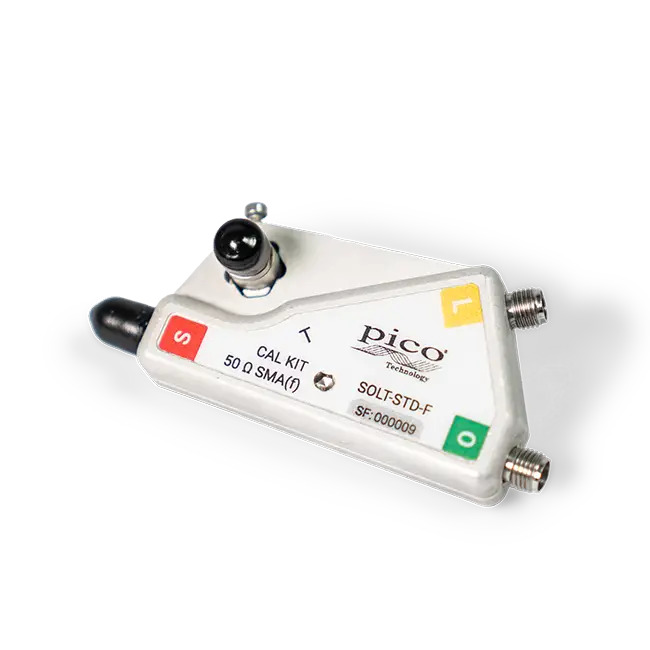
The Standard 8.5 GHz SOLT Calibration Kit with SMA Female Connectors, order code TA345, is a manual mechanical calibration kit designed for PicoVNA and compatible 50 Ω vector network analysers.
The kit contains:
- SMA female short standard
- SMA female open standard
- SMA female 50 Ω load standard
- SMA female through adaptor
- Four-piece, five-port construction
- 300 kHz to 8.5 GHz characterisation
- Serial-number-specific traceable calibration data
- Tight-tolerance stainless steel connectors
- Protective carrying case
The standards are supplied as an assembled five-port unit. They can be separated for individual use, connector inspection, cleaning or refurbishment if one calibration component becomes damaged.
Standard-Grade Manual SOLT Calibration
SOLT calibration uses four known RF reference conditions:
During calibration, the operator manually connects each standard when requested by the VNA software.
The resulting error correction can compensate for systematic measurement errors such as:
- Directivity
- Source match
- Load match
- Reflection tracking
- Transmission tracking
- Forward-path errors
- Reverse-path errors
- Isolation or crosstalk, where included in the procedure
The TA345 is not an automated E-Cal module. The RevineTech page should remove claims related to electronic switching, USB operation and one-touch calibration.
SMA Female Connector Configuration
The TA345 uses SMA female connectors across its short, open, load and through standards.
It is suitable for calibration setups terminating in:
- SMA male test cables
- SMA male test-port adaptors
- Male-ended RF fixtures
- Male connectorised devices
- SMA male calibration reference planes
- RF test assemblies with male cable ends
The corresponding standard-grade male kit is the TA344.
The TA345 should not be described as a mixed male-and-female kit. All five connection ports in the assembled calibration kit are SMA female.
300 kHz to 8.5 GHz Frequency Range
The TA345 is characterised from:
This supports VNA calibration for measurements involving:
- RF filters
- Amplifiers
- Antennas
- Attenuators
- Couplers
- Splitters
- Cables
- Connectors
- Matching networks
- PCB transmission lines
- Wireless modules
- Cellular components
- Wi-Fi and Bluetooth equipment
- GNSS products
- RFID and IoT systems
The page should use the complete range of 300 kHz to 8.5 GHz, rather than only stating 8.5 GHz.
Four-Piece, Five-Port Construction
Pico Technology describes the TA345 as a four-piece, five-port SOLT calibration kit.
The assembly contains:
- One one-port short
- One one-port open
- One one-port load
- One two-port through adaptor
Together, these provide five SMA female connection ports.
This construction allows the standards to be:
- Stored as one protected assembly
- Separated during calibration
- Inspected individually
- Cleaned more easily
- Refurbished if a component becomes damaged
- Replaced without discarding the entire assembly
The modular format is useful for laboratories where calibration standards are used frequently.
Serial-Number-Specific Calibration Data
Each TA345 kit is supplied with traceable calibration data linked to its individual serial number.
The data characterises the actual frequency-dependent behaviour of the:
- Open standard
- Short standard
- Load standard
- Through adaptor
This allows the VNA to account for non-ideal properties such as:
- Open capacitance
- Short inductance
- Electrical delay
- Connector parasitics
- Load mismatch
- Through-adaptor loss
- Through-adaptor phase response
The standards should therefore be used with the calibration data supplied for that specific kit, rather than with generic or ideal standard values.
Standard-Grade Working Calibration Kit
Pico Technology offers standard and premium grades of its manual SOLT kits.
The TA345 is the standard-grade SMA female version and is suitable for regular working calibration, production testing and general laboratory measurement.
| Feature |
TA345 Standard Kit |
TA347 Premium Kit |
| Connector type |
SMA female |
PC3.5 female |
| Grade |
Standard |
Premium |
| Frequency range |
300 kHz to 8.5 GHz |
300 kHz to 8.5 GHz |
| Calibration type |
Manual SOLT |
Manual SOLT |
| Construction |
Four-piece, five-port |
Four-piece, five-port |
| Characterisation |
Serial-number-specific |
Serial-number-specific |
| Typical use |
Working and transfer standard |
Precision or reference calibration |
Many laboratories use:
- A premium-grade kit for reference calibration
- A standard-grade kit for regular working measurements
- A check standard for independent verification
Pico specifically notes that customers may retain both premium-grade and standard-grade calibration standards for different measurement roles.
Load Standard Performance
The TA345 load standard provides the following published return-loss performance:
| Frequency Range |
Uncorrected Return Loss |
Corrected Return Loss |
| Up to 3 GHz |
≥30 dB |
≥40 dB |
| Above 3 GHz to 8.5 GHz |
≥26 dB |
≥37 dB |
Corrected return loss applies when the supplied serial-number-specific calibration data is used.
The load standard supports correction of:
- Directivity
- Source match
- Load match
- Reflection tracking
- Low-reflection device measurements
Open Standard Performance
The open standard provides the following published return-loss limits:
| Frequency Range |
Return Loss |
| Up to 3 GHz |
≤0.15 dB |
| Above 3 GHz to 8.5 GHz |
≤0.20 dB |
The open is not treated as an ideal infinite impedance. Its frequency-dependent capacitance, delay and connector effects are included in the supplied characterisation.
Short Standard Performance
The short standard provides:
| Frequency Range |
Return Loss |
| Up to 3 GHz |
≤0.20 dB |
| Above 3 GHz to 8.5 GHz |
≤0.25 dB |
The calibration data accounts for the standard’s actual delay, loss and inductive characteristics.
Through-Adaptor Performance
The through adaptor provides:
- Maximum insertion loss of 0.25 dB
- Operation up to 8.5 GHz
- Two SMA female ports
- Characterised magnitude and phase response
The through connection is used to calculate forward and reverse transmission-tracking and load-match correction terms during two-port calibration.
Typical Manual Calibration Procedure
A two-port SOLT calibration normally includes:
- Allow the VNA, test cables and standards to reach a stable temperature.
- Inspect the SMA connectors for damage or contamination.
- Load the calibration data linked to the TA345 serial number.
- Select the required SOLT calibration procedure.
- Connect the short standard when requested.
- Connect the open standard.
- Connect the load standard.
- Connect the through adaptor between the two calibrated test ports.
- Apply the specified SMA connector torque.
- Complete and save the calibration.
- Measure a characterised check standard to verify the setup.
- Connect the device under test without moving the calibrated cables.
The calibration kit improves systematic error correction, but measurement quality still depends on the cables, connectors, torque, environment and device under test.
Connector Care and Torque
SMA calibration standards must be handled carefully.
Recommended practices include:
- Inspecting the connectors before use
- Keeping protective caps fitted during storage
- Cleaning only with approved RF connector procedures
- Avoiding rotation of the calibration body while tightening
- Using a calibrated torque wrench
- Avoiding over-tightening
- Protecting the centre conductor
- Minimising unnecessary mating cycles
Connector wear or contamination can increase measurement uncertainty even when the correct calibration data is used.
Calibration Verification
After calibration, an independent check standard can help verify the complete measurement setup.
Compatible Pico check standards include:
- TA430 insertable male-to-female check standard
- TA431 non-insertable female-to-female check standard
Verification can help identify:
- Incorrect calibration sequencing
- Damaged test cables
- Connector contamination
- Incorrect torque
- Cable movement
- Reference-plane errors
- Measurement drift
- Setup configuration mistakes
The SOLT kit creates the VNA error correction. A check standard tests whether the calibrated system produces the expected result.
Compatible VNA Systems
The TA345 can be used with:
- PicoVNA 106
- PicoVNA 108
- Other compatible 50 Ω vector network analysers
- VNA systems supporting characterised SMA female standards
The selected sweep range must remain within the kit’s 300 kHz to 8.5 GHz characterisation.
Applications
The Pico TA345 is suitable for:
- Vector network analyser calibration
- Antenna measurements
- RF filter testing
- Amplifier characterisation
- Cable and connector testing
- Attenuator measurements
- Coupler and splitter analysis
- PCB transmission-line testing
- Wireless module validation
- Cellular product development
- Wi-Fi and Bluetooth testing
- GNSS measurements
- RFID and IoT product testing
- Production-line RF testing
- Research laboratories
- University RF laboratories
- Engineering education
- Working-standard calibration
- Measurement assurance